
Why Quick Answers Are Bad For Learning and Lower Grades
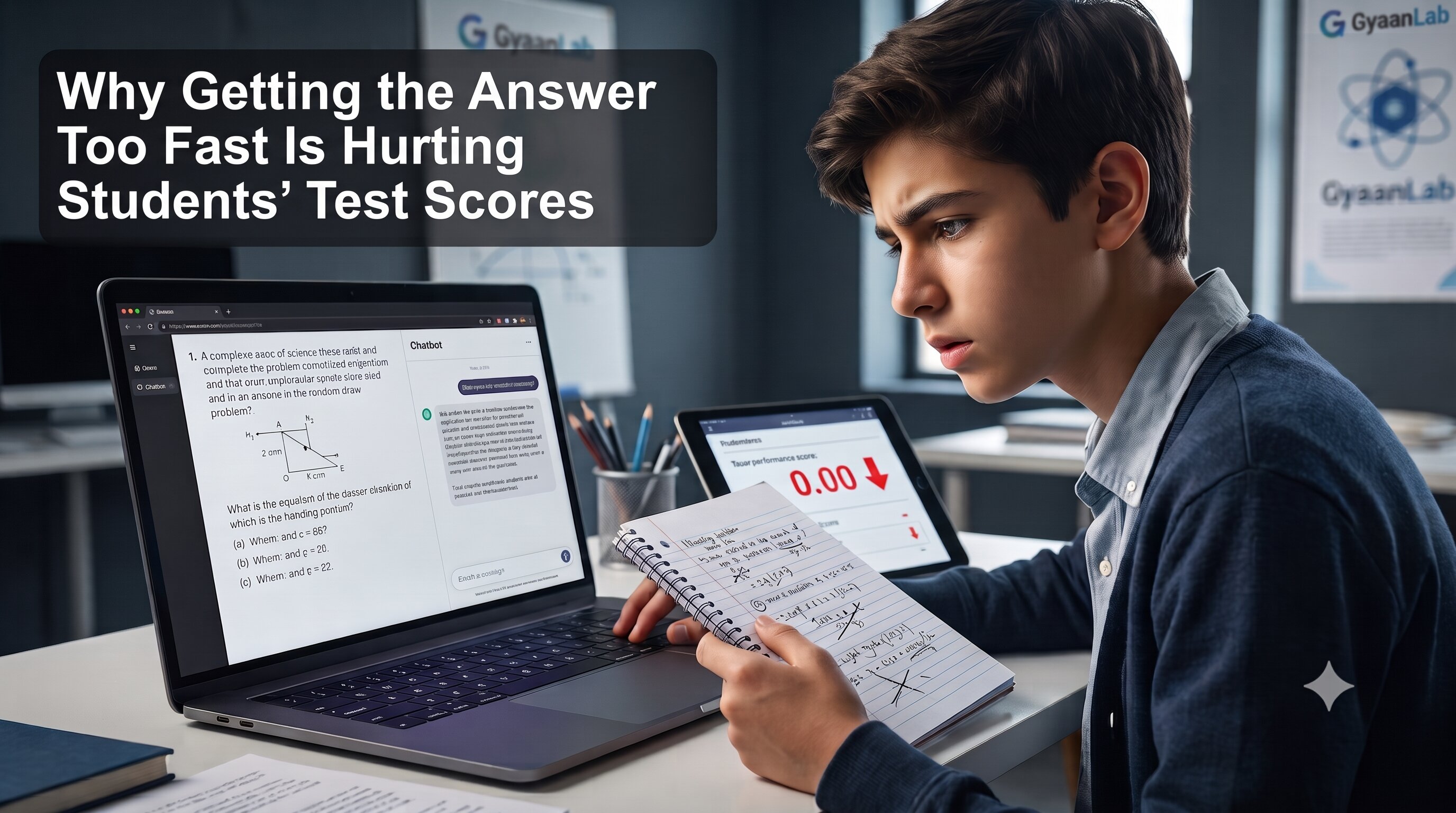
The study was carried out by OECD, a prestigious international organization, and more than 760000 students from 91 countries were involved in it. Here are some of the major conclusions they reached:
Those students who frequently use AI-powered chatbots for writing their assignments or summaries showed a score difference of 28 points in science tests when compared with those who made one or two uses of them only.
In the real school world, that 28-point difference means you forgot about half to three-quarters of the material.
At first this doesn't even seem logical. Students with a 24/7 helpful AI that always explains things clearly—shouldn’t they get great results?
That's the simple fact about learning.
Watching Others Lift Doesn't Make You Strong
The OECD education director gave an example that is close to the topic: you are able to get the perfect shape only if you're working it out yourself, not watching.
Your mind works the same.
The moment of learning that sticks in the memory and helps us to know things better is when we are stuck. That moment of frustration is when we take the time to think about it, try the problem in the way we thought at first and then change the strategy once failed, for instance.
This is when a student goes to a chatbot and asks a question for writing an essay, summarizing a chapter, solving a difficult step etc.
Homework done in just a couple of minutes.
Everything in notebooks has been done and the notebooks look perfect.
Student is happy to know and understands it all.
The down side - the brain's thinking has been left out. AI has been doing almost all of the thinking for the student.
As students didn't work through the steps on their own and were dependent on a very convenient alternative, they didn't memorize the concept. So on the test day, when the student has to figure a question out using only knowledge from memory, he/she is left with a blank.
The Fine Line of Aides and a Coach
We are not saying that having such tools is bad. What we are saying is that students should be careful not to use them as substitutes but rather treat them as training partners.
AI as a crutch (Will lower your grades): Using AI to write a paper, read a summary of a chapter of which you haven't yet read, or getting stuck immediately and going to the AI for an answer.
AI as a coach (Improves your brain): Getting yourself to learn by first carefully reading the text, then practicing math problems on a blank piece of paper, and finally, only when there has been a mistake, using AI to check your way of thinking or to find out what you have missed.
We Are Against AI in Teaching (But only in a limited sense!)
No, we are not against the idea of using AI, it’s the use of a student for doing the whole thing with the help of AI that we oppose. In contrast, we are all in favor of AI-assisted learning where the learner is actively involved, gets to try, and gets help when needed so as to avoid any confusion.
The teacher, in this case, is the one who decides how much to let a student to depend on AI.
The Classroom Perspective
The only real source of confidence at school is not being able to repeat someone else's neat answer but experiencing yourself the challenge of getting a problem wrong, fixing your mistake, and then discovering "Ah! I understand now."
Don't be scared to find that one problem which really throws you. This struggle is not an indication that you are not going to be good and succeed in that field; it's in this exact situation that your brain gains the insight and is in the very process of learning through the hard road.