
Why "Studying Harder" Isn’t Enough for IIT JEE, NEET, and Board Success
High-performance learning isn't just about effort—it’s about systems. Learn how GyaanLab Academy’s team-oriented approach builds the logical foundation students need to conquer Board exams and beyond.
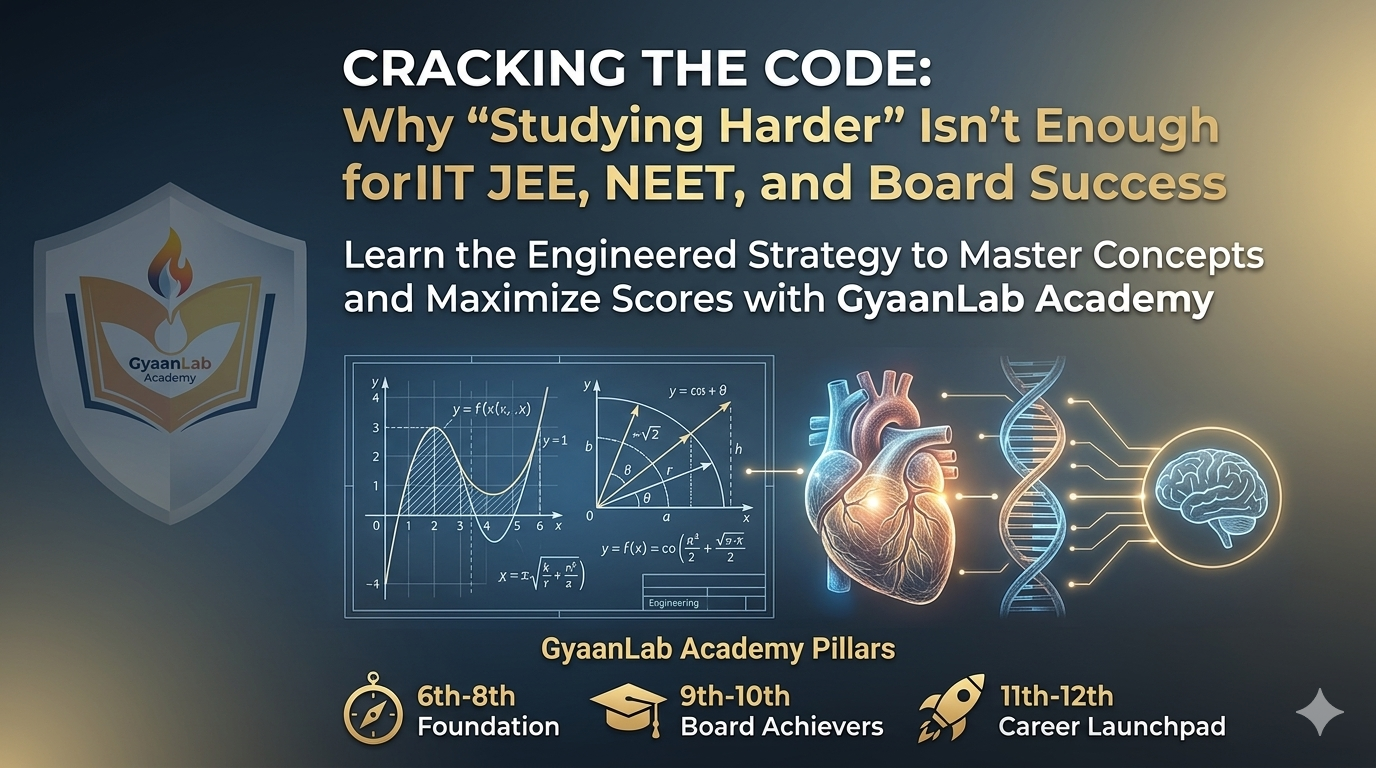
When students step into competitive exam preparation—whether they are entering the 11th-grade Career Launchpad or building early roots in a 6th-grade Foundation program—they are almost always given the same advice: "Work harder. Study longer hours."
But if long hours were the only secret to success, every student pulling an all-nighter would secure a top rank.
The reality of modern competitive exams like IIT JEE, MHTCET, and NEET is that they don’t just test your stamina; they test your strategy. To transition from an anxious learner into a sharp, analytical thinker, you have to stop studying harder and start studying engineered.
Here is how the expert faculty team at GyaanLab Academy breaks down the anatomy of high-performance learning.
1. Shift from Rote Learning to First-Principles Logic
The biggest trap students fall into, especially in subjects like Mathematics and Physics, is memorizing formulas. When a question is slightly twisted in a JEE or NEET paper, rote learning fails instantly.
An engineering mindset teaches us to look at complex problems from "first principles"—deconstructing a massive calculus or mechanics problem into its absolute fundamental truths. When you understand why a formula works, you no longer need to memorize a hundred variations of it. You can derive the solution on the spot.
2. The Power of Micro-Consistency (The DPS Model)
Marathon runners don't sprint 42 kilometers on day one. Similarly, trying to master an entire ocean of syllabus a week before the exam leads to burnout.
Real academic growth happens in small, daily compound interests. This is why a structured framework utilizing Daily Practice Sheets (DPS) is vital. By solving a targeted, high-quality set of problems every single day, concepts move from a student's short-term memory into deep conceptual mastery.
3. Building the Foundation Early
Waiting until the 11th grade to suddenly develop analytical thinking is like trying to build a skyscraper on a weak foundation. The mental models required to crack tough national-level exams—like spatial visualization in geometry or logical elimination in science—take time to mature.
Introducing advanced problem-solving tools, competitive exposure like Olympiads, and calculation speed-boosters like Vedic Mathematics during the 6th to 8th-grade foundation years completely changes the game. It removes the fear of the subject long before the board exams even arrive.
The GyaanLab Approach: A Team Invested in Results
At GyaanLab Academy, we realized that no single individual can guide a student through the entire multi-faceted journey of modern education. It takes a village of specialized educators working in perfect sync.
We built our academy in Kharadi on a collaborative, team-oriented model. Our physics, chemistry, biology, and mathematics divisions work as a cohesive unit to monitor each student's regular test performance, track conceptual blind spots, and maintain optimal batch sizes so no child becomes just a roll number.
Exams like the JEE, NEET, or school Boards are highly demanding, but with the right strategic framework and an empathetic team backing them up, every student can transform their academic dreams into measurable success.
What is the biggest roadblock your child is currently facing in their study routine? Let us know in the comments below, or drop by GyaanLab Academy in Kharadi for a one-on-one diagnostic mentorship session with our expert faculty!